

Marble Floor Grinding
Professional marble floor grinding in Abu Dhabi & Dubai. Diamond grinding removes lippage, scratches & stains. ISO certified.
Reviewed by Delight IFM Technical Team
- Certified Professionals
- Diamond Grinding Equipment
- Same-Day Service
- Satisfaction Guaranteed
- Abu Dhabi & Dubai Coverage
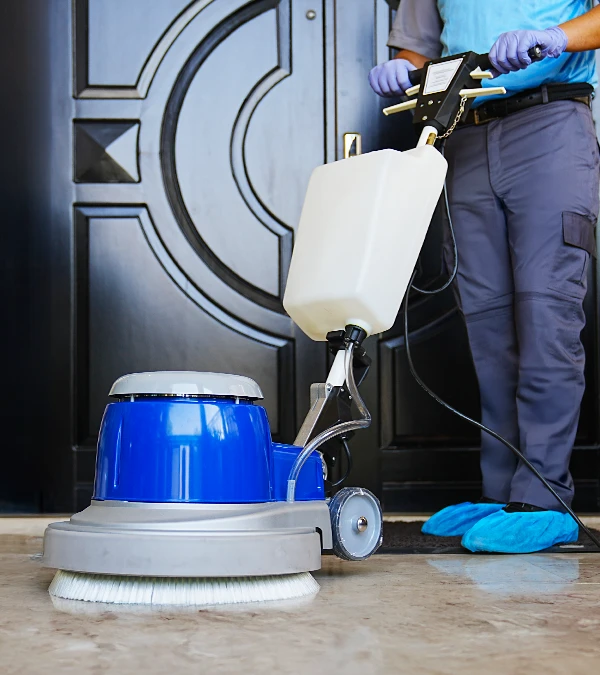
Marble Floor Grinding Solutions
Book Professional Marble Floor Grinding Services with Us Today
Marble grinding is the first real step in any serious marble restoration, and it is the only process that can do three specific jobs: level the lippage between tiles, cut out deep scratches that have gone below the polished surface, and remove embedded stains that no polishing or chemical treatment will ever shift. Delight International Facilities Management does this across Abu Dhabi, Dubai and the wider UAE, using industrial-grade planetary grinding machines fitted with multi-stage diamond abrasives.
We assess every floor on its own, work out the exact diamond grit sequence it needs, and run the grinding with dust-contained equipment so your property stays clean and safe throughout. Leveling a newly installed floor, restoring a worn-out lobby, prepping a villa floor for crystallization, whatever the job, what you get back is a perfectly flat, uniform surface ready for any finish you want on top.
Grinding removes somewhere between 0.5mm and 2mm of stone, depending on how bad the damage is. Standard marble tiles are 15 to 20mm thick, so a floor can be ground several times over its life, which is what makes it one of the most cost-effective restoration options.
How Marble Grinding Works
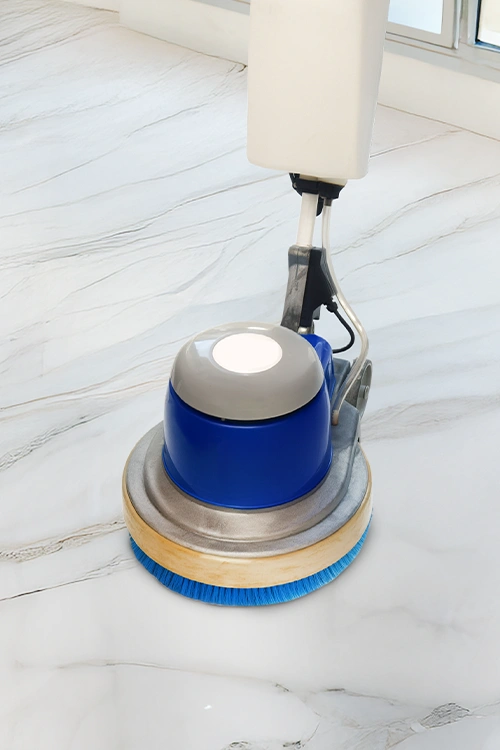
Grinding uses planetary machines weighing 200 to 400kg, with rotating heads that hold diamond-impregnated metal or resin pads. They work across the floor in overlapping passes, which is how you get even material removal rather than a patchy result. The job runs in four stages, and each one has to be finished properly before the next, since skipping or rushing a grit always shows in the final finish.
Stage 1: Coarse Grinding (50–100 grit) — The first pass uses aggressive metal-bond diamond segments to cut through the lippage, take out deep scratches and strip off heavily stained surface material. This is the heavy structural work, leveling tiles that can differ in height by 1 to 3mm and cutting below the worst of the damage. The coarse diamonds leave visible scratch marks of their own, which the later stages refine away.
Stage 2: Medium Grinding (200–400 grit) — Transitional pads refine the scratch pattern the coarse stage left, smoothing the surface and clearing any minor imperfections still there. This is where the boundaries between individual tiles start to blend, giving you the seamless, monolithic look that separates a properly ground floor from one that has only been polished.
Stage 3: Fine Grinding (800–1500 grit) — Resin-bond pads bring the floor to a smooth, honed finish, closing up the marble's pore structure and preparing it for polishing. At this point the floor takes on a soft satin sheen, and the natural veining and color depth of the stone come through clearly.
Stage 4: Honing and Pre-Polish (3000+ grit) — The final grinding stage leaves a uniformly smooth surface with a semi-gloss finish. From here the floor is ready for either crystallization or high-gloss polishing, whichever you prefer.
When You Need Marble Grinding
Newly installed floors are the most common reason for grinding in the UAE. Marble tiles come from the quarry with slight thickness variations of 0.5 to 2mm, and even the most careful installation on a well-prepared substrate ends up with some lippage. Grinding after installation turns a set of individual tiles into one continuous, seamless floor with uniform reflectivity, which is why most premium installations in hotel lobbies, luxury homes and commercial towers specify it as standard from the outset.
Then there are the heavily trafficked commercial floors that build up deep wear over the years, especially at the entrances, the lift lobbies, the corridors and reception areas. Sand-laden shoes make foot traffic particularly abrasive in the Gulf, and years of it leave visible dull patches and shallow depressions that polishing cannot fix. Grinding brings those high-traffic zones back to match the rest of the floor, and it can add decades to the usable life of the marble.
Post-construction and renovation damage is another big one. Building work exposes a marble floor to dropped tools, dragged equipment, paint spills, adhesive residue and cement slurry that etches and stains the surface, and that mix of damage is usually too serious and too varied for polishing to sort. One grinding cycle after the construction is done brings the floor back to its original condition.
And floors with staining that has soaked in, from hard water, rust, oil or organic sources, need grinding to physically remove the contaminated layer of stone. This is common in UAE kitchens and bathrooms, where hard-water mineral deposits leave a yellow-brown discoloration that no surface cleaning will touch.
Regional Considerations
The UAE's climate and its construction environment throw up specific problems that make marble grinding both more necessary and more technically demanding than it would be in a temperate region.
Sand and abrasion — Fine desert sand gets carried into buildings on shoes, through open windows, and through the air handling systems despite the filtration. It works as a natural abrasive, speeding up wear and leaving micro-scratches that dull a polished finish faster than in a sand-free environment. Properties with direct desert exposure, villas in communities like Arabian Ranches, Saadiyat and Al Reem, generally need grinding on a shorter cycle than a fully enclosed high-rise apartment.
Hard water mineral deposits — The UAE's water is high in calcium and magnesium, which leave white limescale deposits on marble. Over time those minerals etch into the stone, creating rough patches and permanent discoloration. In wet areas, bathrooms, kitchens, pool surrounds, this hard-water damage is the main reason for grinding, because the deposits go below the polished surface layer and chemical treatment alone will not remove them.
Temperature and humidity — Summer temperatures over 50°C cause thermal expansion in the marble slabs, while the air-conditioned interior sits around 22°C. That repeated thermal cycling, season after season, can cause slight tile movement and bring lippage back to a floor that started out level. The summer humidity adds moisture migration through the stone, drawing subsurface salts up to the surface in the process called efflorescence. Grinding deals with both the structural and the surface side of all this.
Our teams carry dust extraction systems rated for the fine particulate you get in Gulf properties, and we use water-cooled grinding where it helps manage the heat the process generates. We schedule around what each property needs, from a single-room residential job that finishes in a day to a multi-phase commercial project running over weeks, with after-hours working to keep businesses running.
Signs Your Marble Floor Needs Professional Grinding
Marble gets steadily worse when grinding is put off. Uneven surfaces trap dirt, scratches deepen under foot traffic, and stains work further into the stone. Spotting these signs early prevents irreversible damage and saves you the far higher cost of replacing the floor outright.
Uneven Tile Edges Catching Feet or Furniture
Lippage is when adjacent tiles sit at slightly different heights, leaving raised edges that catch shoes, furniture legs and vacuum wheels. In the UAE, fast construction timelines and substrate settling often bring it on even with recently laid floors. It is more than a trip hazard, too: those exposed edges chip and crack under daily traffic, which only widens the height difference over time. Diamond grinding is the only real way to level the tiles back to a single flat plane without lifting and re-laying the whole floor.
Deep Scratches That Polishing Cannot Remove
Surface scratches polish out fine, but a deep gouge, from construction work, dragged furniture or a dropped object, cuts below the polished layer into the body of the stone. Those stay visible no matter how many times you polish over them, and they collect dirt that darkens the mark further. A simple test: if your fingernail catches noticeably as it crosses a scratch, the damage has gone past what polishing can fix, and grinding is needed to take off enough material to reach below it.
Heavy Staining Penetrated Below the Surface
Marble is porous, so spills, coffee, wine, rust, cooking oil, hard-water minerals, can soak well below the polished surface. Once a stain is that deep it becomes part of the stone and resists every topical cleaner, poultice and surface treatment you try. The tell-tale yellow or brown discoloration around kitchen counters and bathroom floors in UAE properties is usually exactly this, embedded staining that only grinding can resolve, by taking the contaminated layer of stone away entirely.
Post-Installation Tiles Not Level or Flush
A newly installed floor often shows lippage, because the tiles arrive with slight thickness variations, the adhesive bed is never perfectly uniform, and the substrate screed may not be laser-level. Plenty of owners in Abu Dhabi and Dubai only realize after installation that their marble does not have the seamless, mirror finish they were expecting. Grinding after installation is standard industry practice for exactly this: it turns a set of individual tiles into a monolithic, gap-free floor with even reflectivity.
"Schedule your professional marble floor grinding service today and enjoy reliable results with maximum efficiency. Request a Quote, Call 800 3436"
Benefits of Professional Marble Floor Grinding
Here is what professional marble floor grinding does for your property, backed by ISO-certified processes and trained specialists across the UAE.
-
Perfectly Flat, Level Surface Across Entire Floor
Diamond grinding takes out the lippage and the height differences between tiles, leaving a single continuous plane across the whole floor. That does several things at once: it brings up the mirror reflectivity of the marble, removes the trip hazards, and gives you the uniform base that high-quality polishing or crystallization needs. A level floor is also easier to maintain afterwards, since cleaning machines and mops glide over it without catching on raised edges.
-
Complete Removal of Deep Scratches and Damage
The multi-stage diamond process removes stone down to below the depth of the existing scratches, gouges and surface damage. Starting coarse and working through finer and finer diamonds, it erases all the visible damage while keeping the surface profile even. What you are left with looks newly installed, free of the wear marks built up over years of use, construction or furniture being dragged about.
-
Preparation for Flawless Polishing or Crystallization
Grinding creates the ideal base for whatever finish comes next. Without it, polishing or crystallization cannot give you a uniform gloss, because they simply follow the contours of any imperfection already there. A properly ground floor takes polish evenly across its whole surface, which is how you reach the deep, reflective shine that defines the premium marble in luxury homes, hotel lobbies and commercial spaces across the UAE.
-
Dust-Contained Process Safe for Occupied Spaces
Modern grinding machines come with integrated vacuum systems and dust shrouds that catch the marble particles at source, before they can spread through the property. That containment is what lets us grind in an occupied home, an active office or a working commercial building without a full evacuation or temporary relocation. The air quality stays safe throughout, and there is very little to clean up afterwards.
Marble Floor Grinding — Project Gallery
Explore our completed marble floor grinding projects showcasing quality craftsmanship and attention to detail.
Frequently Asked Questions
What is marble floor grinding?
It is the process of removing a thin layer of stone, usually 0.5 to 2mm, with planetary machines and multi-stage diamond abrasives. It is the only method that levels lippage between tiles, removes deep scratches, and takes out embedded stains, and it is the first step before polishing or crystallization.
How long does marble grinding take?
It depends on the area and the condition. A single residential room can be done in a day, while a large or badly damaged commercial floor runs across several days or a multi-phase project. We give you a clear timeline after assessing the floor.
Will grinding damage my marble floor?
No, done correctly it extends the floor's life. It removes only 0.5 to 2mm of stone, and since tiles are 15 to 20mm thick, a floor can be ground several times over its lifetime. The key is completing each grit stage properly, which is exactly what a professional process ensures.
Should I grind or just polish my marble?
Polishing is fine for surface dullness and light scratches. But if you have lippage, deep scratches your fingernail catches on, or staining that has soaked into the stone, polishing will not fix it, and grinding is required. When in doubt we assess the floor and tell you honestly which one it needs.
Can marble grinding be done in occupied buildings?
Yes. Our machines have integrated vacuum systems and dust shrouds that capture the particles at source, so we can work in occupied homes, offices and commercial buildings without evacuation. The air stays safe throughout and clean-up is minimal.
What Our Clients Say
Trusted by homeowners and businesses across Abu Dhabi & Dubai
“Excellent partition and painting work by Delight IFM. The office partition installation was neat and professional. Painting quality was top-notch. Completed ahead of schedule.”
“Delight IFM handled our kitchen renovation and general maintenance perfectly. The team was skilled, tidy and respectful of our home. The kitchen transformation was amazing. Highly recommend their services.”
“We have annual maintenance contract with Delight IFM, they are providing excellent service for our AC, plumbing and electrical issues. The technicians are skilled and always arrive on time. Highly recommended for AMC services.”